The Magic of Slide Film
The Image above is of a roll of Kodak Ektachrome 100 for 35mm. I find the packaging quite beautiful indeed, what with the dark blues and the vibrant yellows
First Impressions
I recently had the pleasure of shooting Slide Film for the first time, specifically Kodak Ektachrome 100, Fujifilm Velvia 100, and Adox Scala 50.
Although my experience is still limited, I wanted to share my thoughts here. For now, I’ll mostly focus on Kodak and Fuji, as I’m still waiting for my Adox Scala 50 scans.
What Is Slide Film?
If you haven’t shot Slide Film before, you might know it by a few other names:
Colour Reversal Film
Colour Positive Film
Transparency Film
All these terms mean roughly the same thing. For simplicity, I’ll call it Slide Film from here on.
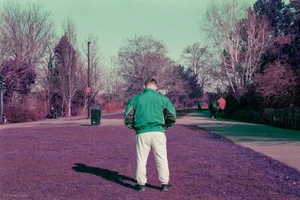
Kodak Ektachrome 100 shot on my Contax RTS in Amberg Germany. By clicking on the link below, it will take you to my other images from this roll https://charlesdaviesphotography.co.uk/timeline-of-film/kodak-ektachrome-100-35mm
Unlike colour negative film, which produces a negative image, Slide Film gives you a positive image straight from the camera. This changes the way you approach shooting — it’s slower, more deliberate, and demands careful composition. With Slide Film, you need to nail exposure just right.
If you overexpose by just a little, then the resulting image will be very blown out and you may lose detail in the brightest portions such as the shadows, and its the other way around if you underexpose. You may hear people say “should I expose for the highlights or expose for the shadows.” This is because by exposing for the highlights you will retain the information in the bright areas but the shadows will be completely black and if you expose for the shadows then the highlights will become overexposed.
Editing vs. Straight Out of the Camera
Film shooters often debate whether they “edit” their images. Even if you scan a roll and don’t touch it in Lightroom or Photoshop, you’re technically editing it. Every scanner renders colours differently, whether it’s a phone, flatbed, camera, or a $25,000 drum scanner.
Camera scanning is another example: Fujifilm and Canon cameras produce different colour results. Brands have unique “colour sciences,” and that affects the final image.
With colour negative film, you need to invert the image before sharing it online. You can do this using:
Negative Lab Pro (requires Lightroom subscription)
FilmLab (iOS/iPad, mobile-friendly)
Darktable (free, open-source)
Manual inversion in Lightroom (adjusting the tone curves)
The point is that even “straight” colour negative images require editing whether you like it or not. The same goes for B&W Negative Film. Slide Film is different. You get the final image straight from the camera — no edits, no second-guessing, just what your lens captured at that moment. You are practically looking through a window into the past. There is no “second image” there is only this image and this image is the image you saw when you were composing for your photograph.
Experiencing Slide Film
Before digital photography, people viewed images in a few ways:
Darkroom prints – physical photographs developed and printed
Slide Projectors – mounted slides projected onto walls or screens
Slide projectors gave rise to the term “slideshow.” After development, labs mounted each frame in a small holder or a little mini “picture frame”. You’d load them into a projector or carousel, close the curtains, and watch your images come to life. The carousel even cycled through automatically, letting you sit back and enjoy the show.
The Importance of Slide Film
Beyond home use, Slide Film had critical professional uses:
Medical – before photocopiers, hospitals documented records and cases on slides.
Military – reconnaissance and intelligence photography.
Publishing and advertising – magazines, books, and campaigns relied on the sharp colours of slides.
Science and research – labs, universities, and observatories used it for documentation.
Art and museums – artists and institutions archived work and exhibitions on slides.
Slide film was everywhere. Everyone from doctors to scientists, military personnel, publishers, and artists relied on it.
Kodachrome: The Legendary Slide Film
One of the most famous slide films was Kodachrome. Introduced in 1935 for motion pictures and 1936 for still photography, it was sadly discontinued in 2009, with the last roll developed in 2010.
Kodachrome was complex. It used the K-14 process, which required 14 steps to develop a single roll — far more involved than today’s standard E-6 slide films, which use 6 steps. The chemicals were hazardous, expensive, and environmentally unfriendly.
Kodachrome delivered colours unlike any other film. Even today, reproducing its look is nearly impossible. You could technically develop it as black-and-white, but that removes the magic entirely.
The Future of Slide Film
Although less common today, Slide Film is still available. I hope it continues to thrive. It would be a sad day if major brands like Kodak and Fujifilm stopped producing it.
Perhaps someday, new manufacturers will produce modern slide films with the same magic and colour fidelity as Kodachrome — but in a safer, environmentally friendly way.
Kodak Ektachrome 100 shot on my Contax RTS in Amberg Germany. By clicking on the link below, it will take you to my other images from this roll. https://charlesdaviesphotography.co.uk/timeline-of-film/kodak-ektachrome-100-35mm
Final Thoughts
Shooting Slide Film is like looking through a window into the past. Each frame captures exactly what the camera saw at that moment — unedited, true to life, and permanent. It’s slower, more thoughtful, and in many ways, more rewarding than digital photography.
Thank you